The Complete History of the Vietnam DMZ
The Vietnam Demilitarized Zone (DMZ) is one of the country’s most historically significant regions. Although it was intended to serve as a temporary buffer between North and South Vietnam after the Geneva Accords of 1954, the DMZ became one of the most heavily fortified and fiercely contested areas during the Vietnam War.
Today, the former DMZ is a destination where visitors can explore battlefields, underground tunnels, military bases, memorials, and museums while learning about one of the defining conflicts of the 20th century.
Whether you are a history enthusiast, a veteran, or a traveler seeking a deeper understanding of Vietnam’s past, exploring the DMZ offers an unforgettable journey through history.
What Was the Vietnam DMZ?
The Vietnam DMZ was established in July 1954 following the Geneva Accords, which temporarily divided Vietnam after the First Indochina War.
The boundary followed the Ben Hai River near the 17th Parallel in present-day Quang Tri Province.
Despite its name, the Demilitarized Zone was never truly free of military activity. Instead, it became one of the most militarized borders in the world.
The zone stretched approximately 5 kilometers (3 miles) on either side of the Ben Hai River, creating a buffer intended to prevent armed conflict between the two sides.
Why Was the DMZ Created?
The Geneva Accords aimed to:
- End the First Indochina War.
- Separate military forces temporarily.
- Prepare for nationwide elections planned for 1956.
- Reduce immediate military tensions.
However, the proposed elections never took place, and political differences between North and South Vietnam deepened.
As tensions escalated, the DMZ transformed from a political boundary into a major front line.
Timeline of the Vietnam DMZ
1954 – Creation of the DMZ
After the French defeat at Dien Bien Phu, the Geneva Conference divided Vietnam into two temporary zones.
Key developments included:
- Establishment of the 17th Parallel.
- Withdrawal of French forces.
- Separation of North and South Vietnam.
- Formation of the Ben Hai River boundary.
Although intended as a temporary arrangement, the division lasted more than two decades.
1955–1964 – Rising Tensions
During the late 1950s:
- Border security increased.
- Military patrols expanded.
- Civilian movement became heavily restricted.
- Families found themselves divided across the border.
The region remained unstable as both sides strengthened their military presence.
1965–1967 – Escalation of War
As the Vietnam War intensified:
- United States Marines established bases south of the DMZ.
- North Vietnamese forces reinforced positions north of the Ben Hai River.
- Heavy artillery exchanges became common.
- Air strikes increased throughout Quang Tri Province.
The DMZ became one of the war’s most dangerous regions.
1968 – The Year of Major Battles
The Tet Offensive brought widespread fighting across South Vietnam.
Near the DMZ, several important battles took place, including:
Battle of Khe Sanh
Often compared to the Battle of Dien Bien Phu, the siege of Khe Sanh lasted 77 days.
The battle involved:
- Thousands of US Marines.
- Continuous artillery bombardment.
- Massive American air support.
- Intense fighting in mountainous terrain.
Although the base remained under American control during the siege, it was later abandoned.
1972 – Easter Offensive
The Easter Offensive marked one of the largest conventional military campaigns of the war.
North Vietnamese forces crossed the DMZ with tanks and infantry.
Major battles occurred around:
- Quang Tri City
- Dong Ha
- Camp Carroll
- Cua Viet
The province suffered widespread destruction during months of intense combat.
1973 – Paris Peace Accords
The Paris Peace Accords resulted in:
- Withdrawal of American combat forces.
- Prisoner exchanges.
- Continued conflict between North and South Vietnam.
Although international involvement declined, fighting near the DMZ did not completely end.
1975 – Reunification
In March 1975, North Vietnamese forces launched the Spring Offensive.
Within weeks:
- Quang Tri was secured.
- Hue fell.
- Da Nang was captured.
- Saigon fell on April 30.
Vietnam was officially reunified in 1976, ending the division that had defined the DMZ.
Life Along the DMZ
The war dramatically affected civilians living near the border.
Many families experienced:
- Forced evacuations.
- Constant shelling.
- Underground living.
- Separation from relatives.
Entire communities relocated to survive the conflict.
The Vinh Moc Tunnels
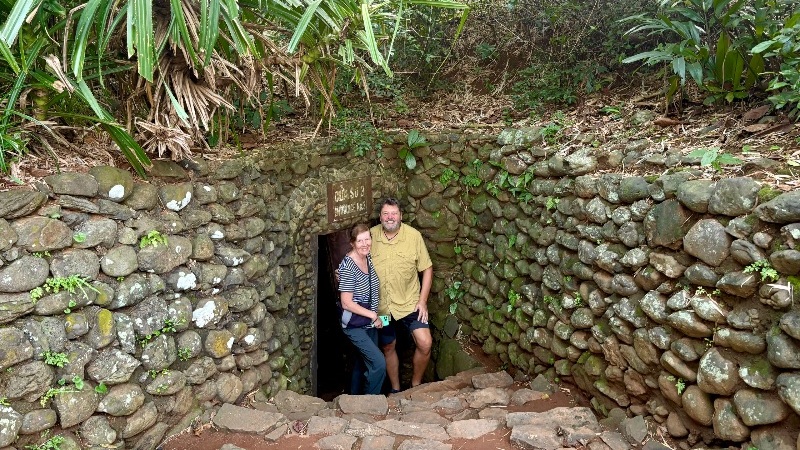
One of the most remarkable sites near the DMZ is the Vinh Moc Tunnels.
Unlike military tunnels used primarily for combat, Vinh Moc functioned as an underground village.
Features include:
- Nearly 2 kilometers of tunnels.
- Living quarters.
- Kitchens.
- Medical stations.
- Wells.
- Maternity area where several children were born underground.
The tunnels protected hundreds of civilians during years of bombing.
Hien Luong Bridge and the Ben Hai River
The Hien Luong Bridge became one of the strongest symbols of Vietnam’s division.
For over twenty years:
- North Vietnam controlled one side.
- South Vietnam controlled the other.
- Loudspeakers broadcast propaganda across the river.
- Families could often see—but not visit—their relatives across the border.
Today, the bridge stands as a symbol of peace and national reunification.
Important Vietnam DMZ Historic Sites
Visitors exploring the former DMZ should not miss:
Hien Luong Bridge
The iconic crossing over the Ben Hai River marking the former border.
Ben Hai River
The natural feature that became Vietnam’s temporary dividing line.
Vinh Moc Tunnels
An underground civilian shelter preserved as a historical site.
Khe Sanh Combat Base
One of the most famous American military bases during the war.
Rockpile
A strategic observation point used by US Marines.
Camp Carroll
A former artillery base that played an important role during the Easter Offensive.
Quang Tri Citadel
Site of the fierce 81-day battle in 1972 and today an important national memorial.
Visiting the Vietnam DMZ Today
Many travelers join guided tours from Hue or Dong Hoi to explore the former DMZ.
Popular tour highlights include:
- Hien Luong Bridge
- Ben Hai River
- Vinh Moc Tunnels
- Khe Sanh Combat Base
- Ho Chi Minh Trail
- Ta Con Airfield
- Quang Tri Citadel
A full-day or two-day itinerary allows enough time to understand both the military history and the human stories behind the conflict.
Why Visit the Vietnam DMZ?
Visiting the Vietnam DMZ offers more than an opportunity to see former battlefields. It provides insight into the political divisions, military strategies, and civilian experiences that shaped modern Vietnam.
The preserved landmarks, museums, and memorials help visitors understand how a temporary border became one of the most significant locations in the Vietnam War.
Frequently Asked Questions
Where was the Vietnam DMZ located?
The Vietnam DMZ was centered on the Ben Hai River near the 17th Parallel in present-day Quang Tri Province.
Can tourists visit the Vietnam DMZ?
Yes. Most historic sites are open to visitors, and guided tours operate year-round.
How long does a DMZ tour take?
Most tours last one full day from Hue or Dong Hoi, though multi-day tours are available for those interested in exploring additional battlefields.
Is the Vietnam DMZ still active?
No. The DMZ ceased to exist after Vietnam’s reunification in 1976. Today, it is a peaceful historical region.
Final Thoughts
The history of the Vietnam DMZ reflects one of the most significant chapters in modern Vietnamese history. Created as a temporary boundary, it became the center of decades of conflict before finally giving way to reunification and peace.
Today, visitors can walk across the Hien Luong Bridge, explore the Vinh Moc Tunnels, stand inside the remains of Khe Sanh Combat Base, and reflect on the experiences of both soldiers and civilians. A journey through the former DMZ is not only an exploration of military history but also a reminder of resilience, reconciliation, and the enduring desire for peace.